At a glance
- What it is: the principles that guide teaching, training, accompaniment and research at the Institute.
- Its origin: an intuition from 2010: diplomacy can become an object of study and research.
- Five parts: the foundations; discernment; learning processes; accompanying, evaluating, revisiting; researching and aiming for peace.
- A living text: meant to evolve.
Understand the phenomena of the world.
Develop reference points for action.
Exercise diplomatic discernment.
Preamble
The Institut Diplomatique de Paris was born in 2010 from an intuition: diplomacy is more than a profession or a set of techniques. It can become an object of study and research. Diplomatic Sciences take diplomacy as their common object. They bring together political science, international relations, law, history, economics, geopolitics, sociology, negotiation, cultures and knowledge drawn from experience.
A private, free and independent institution of higher education, the Institute was, in the words of its founder, “created with the heart, to serve”. This manifesto brings together the reference principles that guide teaching, training, accompaniment and research at the Institute.
A living manifesto
This manifesto is not set in stone. Like the discernment it upholds, it always remains perfectible: it will be re-read, questioned and revised as the world, situations and the Institute’s experience evolve.
| I | The foundations | Connecting without reducing, training without conforming; teaching, educating, training and cultivating. |
|---|---|---|
| II | Discernment | The Star of Discernment and its seven moments; argument and critical thinking. |
| III | The processes | F-A-I-C-S-O, the progressions of work, L’Établi, speech and presence. |
| IV | Accompanying and evaluating | The educational relationship, evaluation, integrity, singular ways of thinking. |
| V | Researching and aiming for peace | Research that nourishes training; peace as an aim. |
Part IThe foundations
01 Connecting without reducing
To understand the world is to welcome its contradictions rather than reduce it to a representation that would erase them. The Institute stands against oversimplification: acting and thinking in complexity, distinguishing without separating, connecting without confusing. This requirement has a name, reliance. It means connecting fields of knowledge with one another, knowledge with experience, people with one another. At the heart of the project lies a constant relationship:
SCIENCE ↔ PRACTICE
Knowledge transforms experience, and experience transforms one’s relationship to knowledge.
- Knowledge
- Simulations
- Experience
- Evaluation
- Revisiting
↶ return to knowledge and revisit practice
Penetration is a virtue of understanding: going beyond appearances to enter the complexity of a situation, to grasp its singularities, tensions and deep dynamics, knowing that understanding always remains open. Understanding also means questioning one’s own outlook: the observer thinks from a history, a culture, representations and experiences.
02 Training without conforming
The Institute does not seek to produce a model to which everyone should conform. It regards the person as a subject and a relational being. This subject is capable of building their discernment, encountering otherness and taking responsibility for their choices. The Institute provides knowledge, situations, contradictions and support; it does not decide in place of the learner.
“Setting the person to work is not working on the person.”
Teaching is free from any ideological prescription. Sources are examined, perspectives compared and disagreements worked through. It is also a matter of bringing knowledge, experience and goodwill into dialogue in the service of the common good, with respect for the plurality of viewpoints.
The quality of an education is measured by the people it helps to become: clear-sighted, upright, capable of measure and responsibility. Knowledge moves there from reflection to action. The Institute brings the sciences, knowledge and traditions of wisdom into humble dialogue, in the service of the common good.
03 Four interacting dimensions
TEACH ↔ EDUCATE ↔ TRAIN ↔ CULTIVATE
Teach
Making knowledge available for understanding. One cannot discern what one does not know.
Educate
Helping the person grow through relationship. It means creating the conditions in which they think, choose and decide for themselves.
Train
Bringing knowledge and action into interaction. The cycle is knowledge, experience, action, evaluation.
Cultivate
Broadening one’s relationship to the world. One encounters other histories, other languages, other intellectual traditions, and learns to shift one’s perspective.
Each dimension acts on the others and is transformed in their relationship. Together, they form a systemic approach to education and training.
Part IIDiscernment
04 Discernment, a competence never complete
Diplomatic discernment consists in examining a situation in its complexity. One must assess sources, distinguish facts from interpretations, understand actors and their constraints, compare points of view and weigh the possible consequences of an action. The Institute conceives it in three dimensions, distinct but never separate:
Posture
Contemplative Diplomacy: a posture of involvement-distancing, listening and attention.
Path
The Star of Discernment: a path in seven moments, providing reference points for action.
Aim
Diplomatic Discernment Guided by Wisdom: seeking an action suited to the situation, the actors, the responsibilities and the consequences.
The Star of Discernment: seven interacting moments
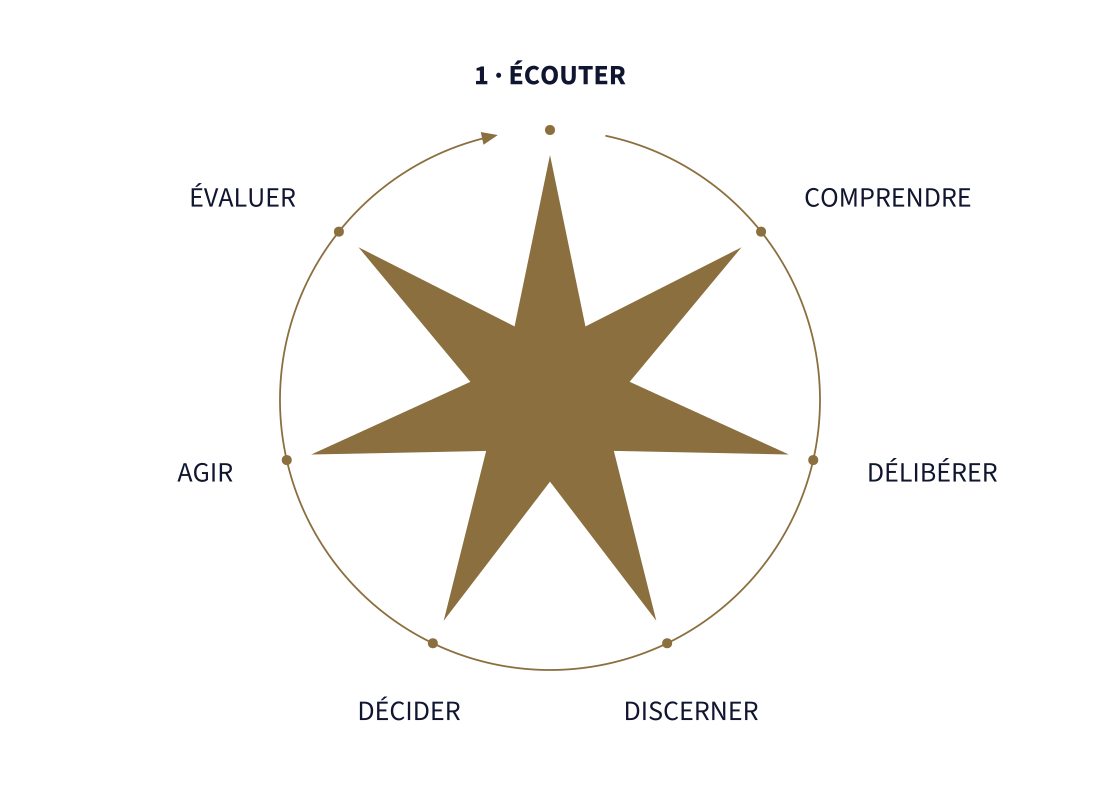
| 1 | Listen | Making oneself available to the situation, the actors, the information, the points of view and whatever may shift an initial representation. |
|---|---|---|
| 2 | Understand | Connecting facts, sources, knowledge, contexts, actors, their representations, their interests and uncertainties without reducing complexity. |
| 3 | Deliberate | Comparing readings, arguments, options, responsibilities and possible consequences before taking a position. |
| 4 | Discern | Exercising one’s discernment in a situation that does not mechanically provide its own answer, and seeking what seems right with regard to the mandate, the actors, the responsibilities and the consequences. |
| 5 | Decide | Taking responsibility for a choice within the limits of the available information, without turning uncertainty into artificial certainty. |
| 6 | Act | Putting the decision to the test of the situation and the relationship, while remaining attentive to the expected and unexpected effects of the action. |
| 7 | Evaluate | Returning to what happened, questioning the discernment and the effects of the action, learning from experience and allowing practice to be revisited. |
These seven moments are neither a recipe nor a linear procedure. They converse with one another, answer one another and may call for revisiting, returns, feedback and re-evaluation. The Star does not decide in place of the person: the decision remains that of the person or authority that bears responsibility for it.
Discernment is situated: it is exercised in action, as close as possible to the real context, here and now. It also engages one’s relationship to time: appreciating the opportune moment, kairos, then dealing with the situation, mētis, in order to choose between acting, waiting, postponing or giving up. Finally, it learns to distinguish examining a position from approving it.
Each act of discernment ends in a decision; the capacity to discern never ends. It calls for reflexivity and constant revisiting.
05 Argument and critical thinking
Argument and critical thinking are practices of discernment: examining sources, distinguishing facts from their interpretations, formulating a reasoned position, listening to objections and revisiting one’s judgement.
Part IIILearning processes
06 A progressive discipline of reasoning: F-A-I-C-S-O
Analysis is based on six complementary questions:
| F | Facts | What do we really know? |
|---|---|---|
| A | Actors | Who acts, decides, influences or is affected? |
| I | Interests | What are the actors seeking? |
| C | Capabilities | What can they really do? |
| S | Scenarios | What plausible developments should be considered? |
| O | Options | What actions are possible, under what conditions and with what consequences? |
This approach teaches one to distinguish fact from interpretation, position from interest, resource from capability, foresight from prediction.
Other progressions structure the work:
The chain of diplomatic practice
- Instructions
- Monitoring
- Interview
- Analysis
- Note
- Briefing
- Negotiation
- Decision
- Action
- Report
- Evaluation
The analysis and research process
- Question
- Source
- Contextualise
- Compare
- Analyse
- Anticipate
- Build options
- Advise
Monitoring
- Observe
- Document
- Contextualise
- Connect
- Question
07 Learning in situation: L’Établi
Practical simulation is the workbench of the artisan of peace.
It is a space for preparing, testing, evaluating and revisiting one’s own practice, in a relationship attentive to others.
- Prepare
- Test
- Evaluate
- Revisit
↶ debriefing and revisiting
The other person is never the material to be worked on. Learners work on their own practice.
Case studies, writing workshops, interviews, briefings, negotiations and simulations are its forms. Each simulation specifies its mandate, rules, productions and criteria. It ends with a debriefing and a revisiting. The Crisis Room, the School Embassy and the specialised laboratories give shape to this approach. So do the simulation exercises. Three capabilities are particularly worked on:
Learning in situation
Recovering from failure and making use of it. Transferring a competence from one context to another. Spotting what does not match expectations. Recognising the moment when one’s usual reference points are no longer enough.
Acting under constraint
Organising one’s action despite uncertainty and respecting the framework of one’s mandate. Knowing when to stop and repairing what can be repaired. When the objective cannot be achieved, withdrawing with method, without worsening the situation.
Learning together
Pooling experiences, sharing what has been learned and comparing contexts. Helping the whole network, participants and alumni alike, to progress from a situation experienced by one of them. This capability extends Emmanuele di Salvo’s research on collective intelligence, developed under the name “Intelligences Unies” (United Intelligences).
08 Speech and presence
In diplomatic practice, speech begins with listening. It develops in a progression:
- Listen
- Formulate
- Express
- Argue
- Represent
- Adapt
The practice also involves presence: posture, non-verbal communication, professional codes, attention to intercultural contexts.
Part IVAccompanying, evaluating, revisiting
The Institute moves from training centred on acquiring competences to a pedagogy centred on supporting competence: competence is built in situation, and the Institute accompanies each person in building it.
09 The educational relationship and accompaniment
Accompaniment helps to organise the work, to make one’s reasoning explicit, to recognise one’s resources and progress. It supports autonomy and responsibility. Three dispositions are its instruments:
HUMILITY → GENEROSITY → WISDOM
Humility
Recognising the limits of what one knows and remaining open to questions, to contradiction and to what one can still learn.
Generosity
Sharing one’s knowledge and experience without taking the other’s place.
Wisdom
Exercising one’s discernment with measure and responsibility.
Recognising one’s limits is a strength: it is the condition for relationship, for solidarity and for openness to what lies beyond each of us.
Professional experience takes on its full value when it can be made explicit, questioned and connected with knowledge: practice then becomes a resource for learning.
10 Evaluating in order to revisit
Evaluation is not reduced to control. It is conceived from subject to subject. It makes it possible to return to the action, to question its effects and to exercise one’s reflexivity. Each piece of feedback is based on observable elements and indicates a priority for progress.
11 Integrity and artificial intelligence
Each piece of work distinguishes documented facts, hypotheses, actors’ positions and recommendations. Sources are identified and borrowings attributed. The use of artificial intelligence tools is declared when it plays a part in the production. The learner remains the author and is responsible for their checks, their reasoning and their argument.
In the age of artificial intelligence, a professional’s value will lie less in what they have memorised than in what they can really do, and in the way they think about it.
Technology always carries the choices of those who design it. The Institute trains people to question these choices, to keep responsibility for judgement and to seek a wisdom that only the person can exercise. It prepares them to move from connection to relationship.
“Science without conscience ruins the life of all.”
Leo XIV, Saint Toribio de Mogrovejo Catholic University, Chiclayo (Peru), 13 November 2026 (translated from the French)
12 Welcoming singular ways of thinking
Artificial intelligence excels at reproducing what has already been thought. It meets its limits in the face of the new situation, the unexpected interlocutor and the decision that commits.
Minds that think differently, and among them neurodivergent people*, may find a particular strength there. Where conventional reasoning runs out, their singular way of approaching a problem opens new paths. The Institute welcomes this plurality of ways of understanding and learning.
* Neurodivergence: neurological and cognitive functioning that departs from dominant social or statistical norms.
Part VResearching and aiming for peace
13 Research that nourishes training
The Institute’s research is organised around three interacting lines:
Line 1
The education and training of diplomatic actors.
Line 2
Diplomatic discernment, decision and action.
Line 3
Diplomacy, peace and conflict transformation.
It does not seek to confirm an established doctrine. It questions concepts, practices, their effects and their limits, then returns to teaching and training.
The quality of the question determines the scope of research, analysis and discernment.
Research and practice converse without merging: each contribution specifies its sources, its method and its standard of proof.
14 Peace as an aim
To educate is an act of hope.
The Institute seeks to be a service of peace. Diplomacy entails a particular responsibility towards it. For the Institute, peace is not the mechanical result of teaching: it is a horizon of responsibility, more demanding than a slogan, more lasting than the promise of a result. It questions the way we understand, encounter others, negotiate, decide and act.
Understanding power relations is essential; to understand them is also to keep the freedom to act upon them. Training for diplomacy means learning to preserve the relationship when interests diverge, to make dialogue possible when positions harden and to seek ways to act when situations seem to close.
Peace is also at stake in the quality of listening, the rightness of discernment, the courage of mediation and respect for one’s word. The Institute works for a diplomacy carried by trained diplomats, and to revitalise diplomacy wherever it is needed.
To become, each in their own field and to the measure of their responsibilities, magnificent artisans of peace.
Paris, November 2026 - translated from the French original
Emmanuele di Salvo
President and Founder of the Institut Diplomatique de Paris
That the world may have peace.